
Notes On Wife-Beating
In which I branch out to a new depressing historical topic

1.
It's surprisingly hard to determine when Western countries outlawed wife-beating.
Pretty much everywhere went through a century-long period where lawyers and judges themselves didn't agree on whether it was legal.
In all civil-law nations, the story was the same:
First—anywhere between the 1680s in Denmark and the 1850s in Portugal—there would be a new Enlightenment-influenced legal code which left out the old explicit recognition of the husband's right to physically punish his wife.
Only around a century later—which means as late as the 1950s in Portugal and Italy—would a new law unambiguously deny that the husband had the right to beat his wife. In the interim, different judges would give different verdicts, and different legal scholars would say different things.
Spain is the freakishly patriarchal exception here: its liberal 1822 code, which talks about how all (non-black) men are equal citizens, explicitly recognizes a husband's right of "correction". This only changed in 1848.
Russia, on the other hand, was—thanks to Catherine the Great!—among the earliest countries to omit references to the husband's right to punish, starting back in the 1760s. (Granted, peasants weren't even theoretically subject to the written family-law code.)
2.
It's even harder to say when the Catholic Church condemned wife-beating.
While there was a minority medieval/early modern canon-law view which condemned it, I can't find any 19th-c. Catholic sources which explicitly forbid it. And the 18th-c. moral-theology works of Alphonsus Ligouri, which explicitly condone wife-beating, were endorsed as reliable moral guides by the 19th-c. papacy.
(Tbf, they also endorse judicial torture, which the papacy told Catholic states to stop using in the 1810s.)
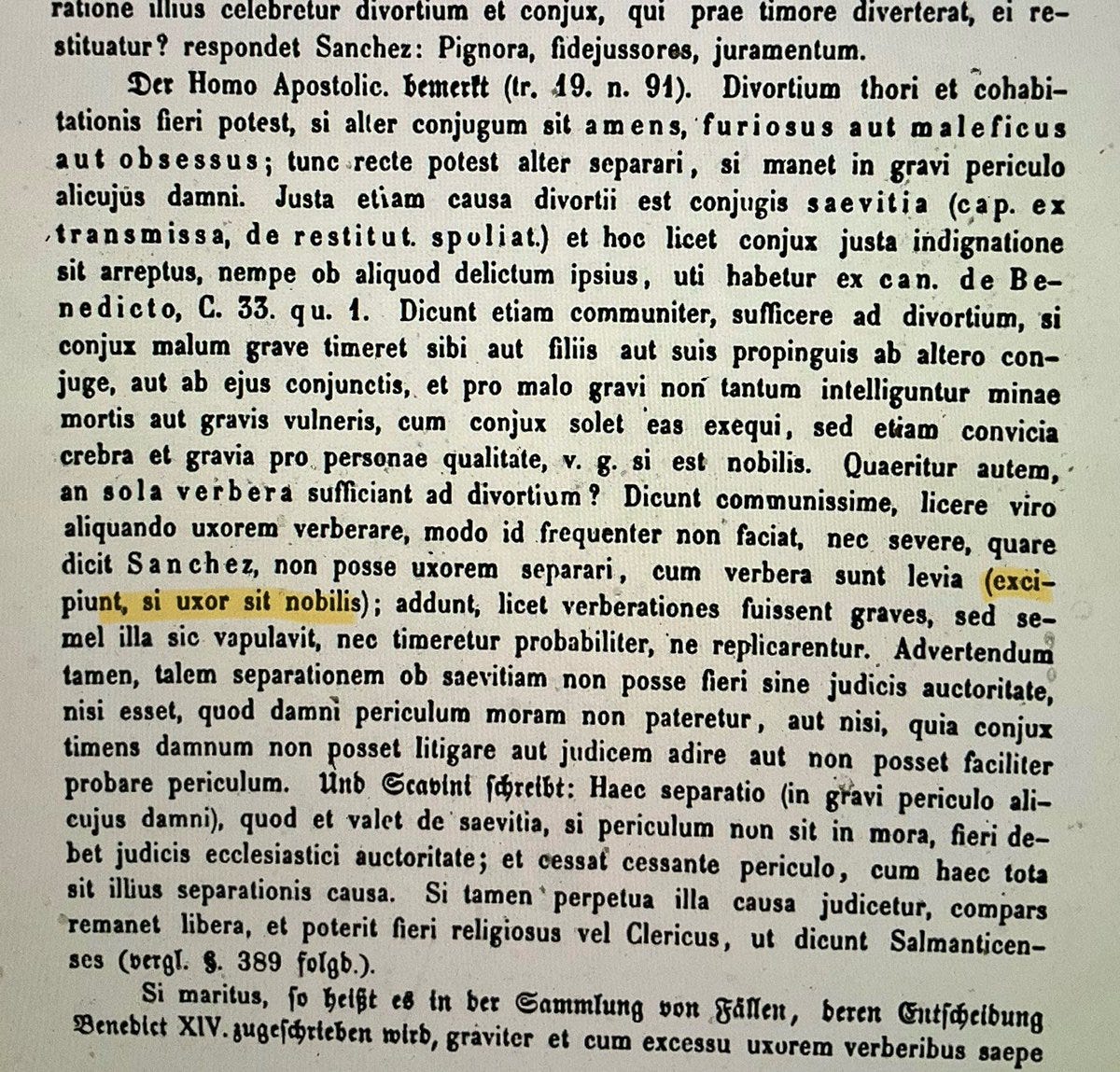
The closest thing to a smoking gun I've found is this 1850s Austrian work on the canon law of marriage, which—in its section on separation for cruelty—approvingly quotes both Thomas Sanchez and the 18th-c. pope Benedict XIV in support of the husband's right to punish:
Das Eherecht der Katholischen Kirche nach seiner Theorie und Praxis
But—unlike Sanchez—he never explicitly discusses the question of whether it's a sin for a man to beat his wife. He only discusses what level of violence justifies a wife getting a separation, and cites these sources to support the idea that 'moderate' beatings don't cut it.
Note that he specifies that a “noble” wife can leave her husband for “mild” beatings. The double standard whereby upper-class wives were more protected from abuse was common in practice, but I’m surprised to see it get official church endorsement.
3.
Pre-modern works have this model of ‘good’ wife-beating that’s totally detached from reality.
It follows their model for ‘good’ beating of children and slaves—calm, not in anger, telling her you love her and this is hurting you more than it’s hurting her, etc. You see it here in an early-17th-c. English Puritan work which (mercifully alone—the Puritans were otherwise very good here) permitted it, but the same instructions show up at the other end of Early Modern Europe in the notorious Russian Domostroy.
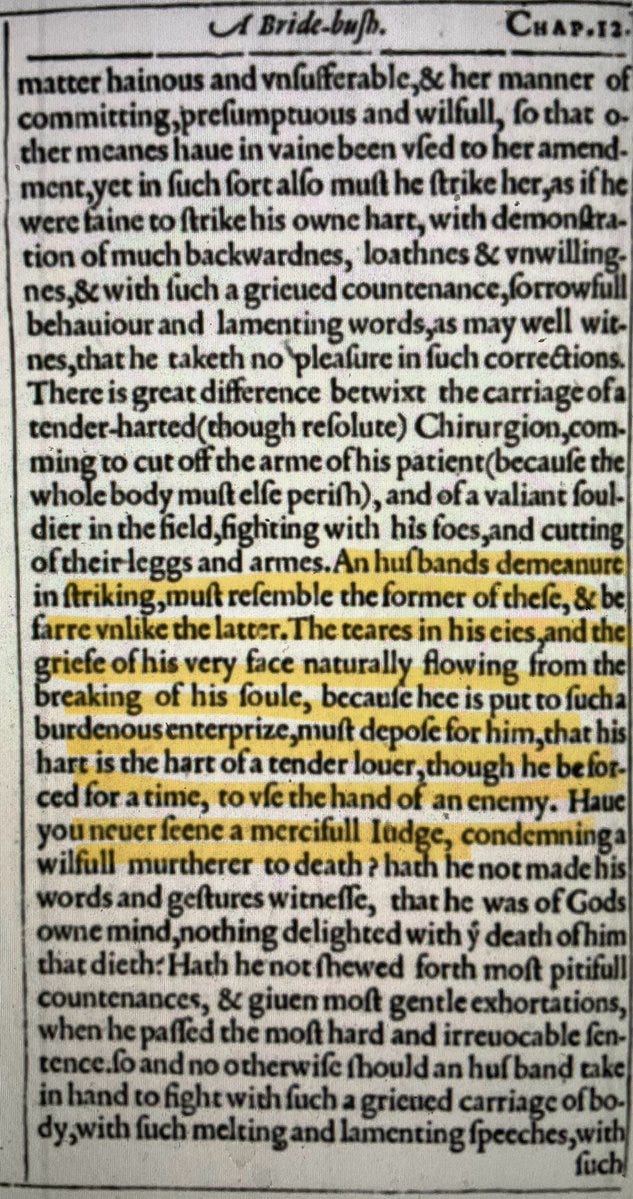
And many parents are actually capable of corporally punishing their children in this way—without lashing out in anger or escalating over time. But even in ultra-patriarchal societies where it’s completely normalized, wife-beating never looks like this.
And the idea of only beating your wife in extreme cases just never happens. A WHO victim survey in Afghanistan found that 50% of women had never been beaten by their husbands—and half had been beaten in the past month. It’s either chronic or it never happens at all.
4.
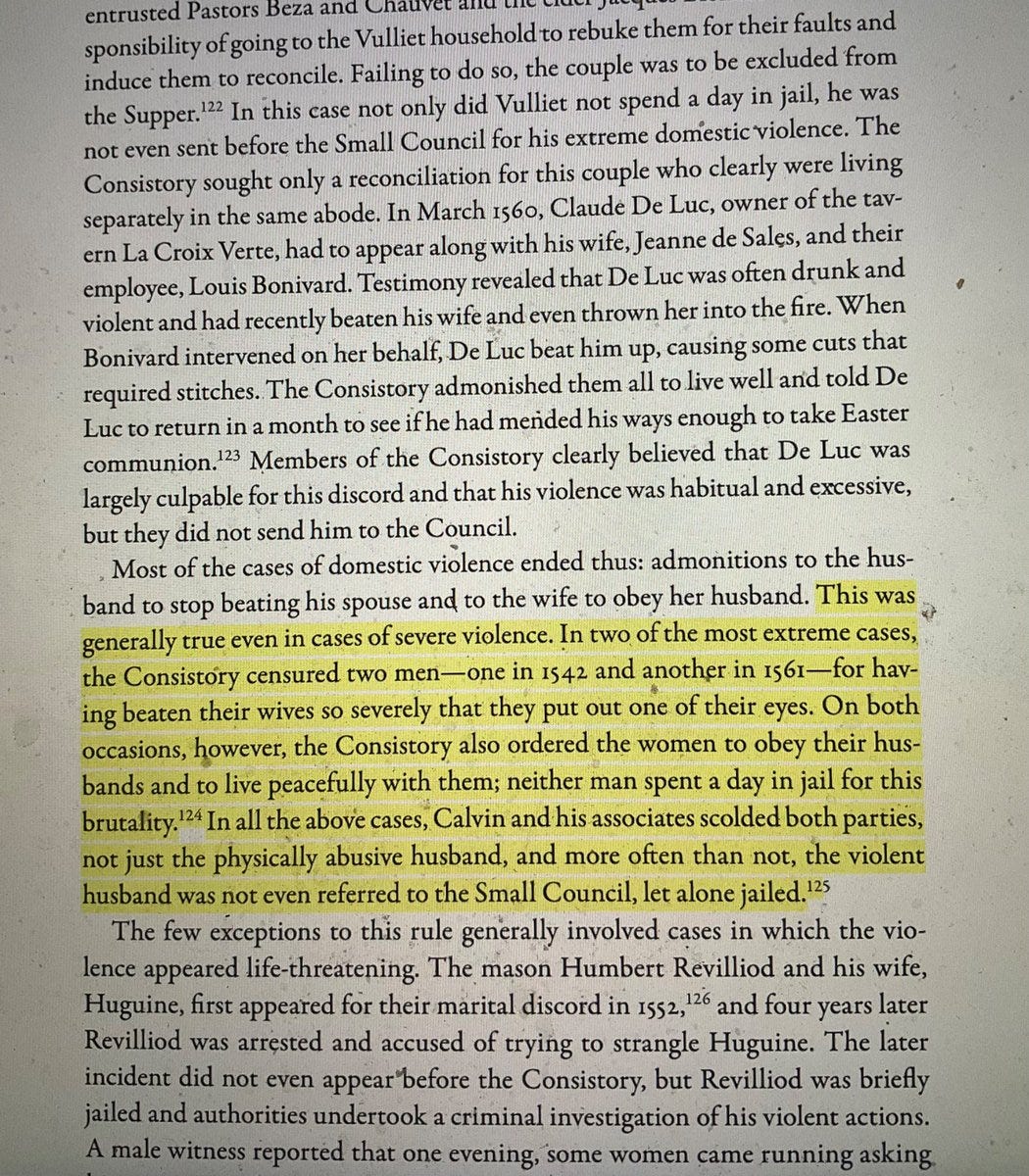
Despite my earlier praise of Calvin’s attitudes to women, his actual treatment of domestic violence was bad even by the standards of the time. On two separate occasions, Genevan men who gouged out their wife’s eye faced zero legal punishment (and the victims were ordered to stay and obey them.)
Protestants—while more inclined than Catholics to condemn wife-beating as sinful—were often opposed to separation for cruelty. Because of their hostility to enforced celibacy, they were extremely suspicious of the whole concept of separation without remarriage. It was the flipside of the same attitude which led them to grant abandoned spouses (overwhelmingly wives) the right to remarry.
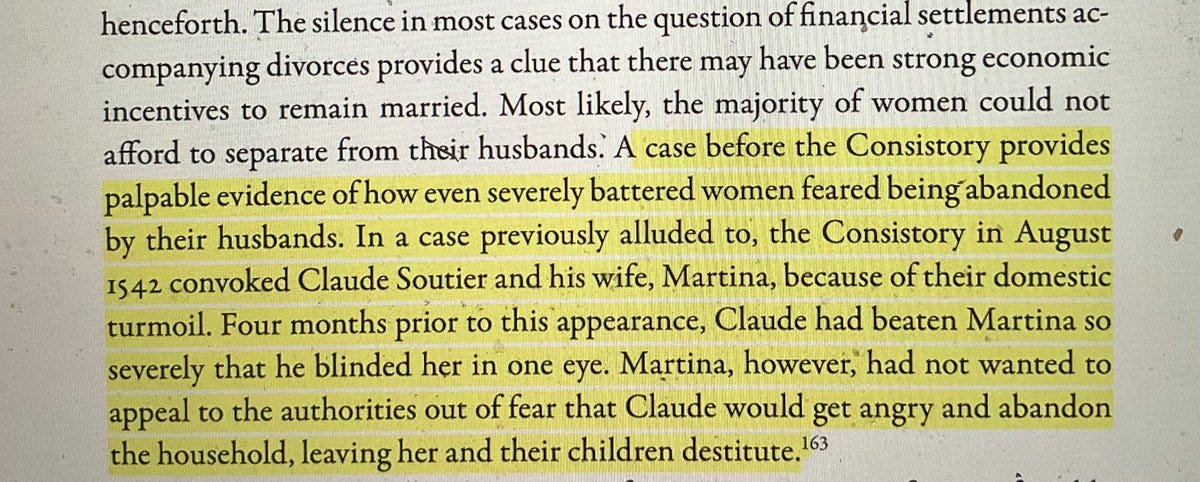
But the right to separate wouldn’t have always helped—one maimed woman delayed reporting the violence to church authorities because she feared her husband would then abandon her and leave her destitute.
5.
Having aired Catholic and Protestant DV-related dirty laundry, I'll move on to Orthodoxy:
This 1870s Russian lay moral handbook condemns cruelty to animals, demanding sex from a sick wife—and wife-beating.
https://azbyka.ru/otechnik/Evgenij_Popov/nravstvennoe-bogoslovie-dlja-mirjan/2_324
(It’s the same one from my note that condemns falling asleep while nursing.)
But it also says it's a sin for a wife to tell anyone about abuse. Even a priest can only be asked to mediate if both spouses agree. Going to the local magistrates is specifically and strenuously forbidden.
(The book frames it as a gender-neutral commandment to respect family privacy by not telling anybody about your spouse’s bad behavior—like, a husband also shouldn’t complain to other people about his wife’s nagging—but the reference to not getting the magistrates involved makes me think the author had to have had domestic violence in mind as well.)
This seems utterly unprecedented. Even before separation for cruelty was allowed in the west, wives could get church courts to threaten their abusive husbands with excommunication.
How do we know, whether the "uxor nobilis" refers a social state of nobility or one's character's descriptor?
I vaguely remember reading that the US (and other Western countries) used to be in denial about wife-beating as a widespread problem before feminist advocacy in the 1900s. Is that accurate? Or just a case of tumblr-screenshot-history?